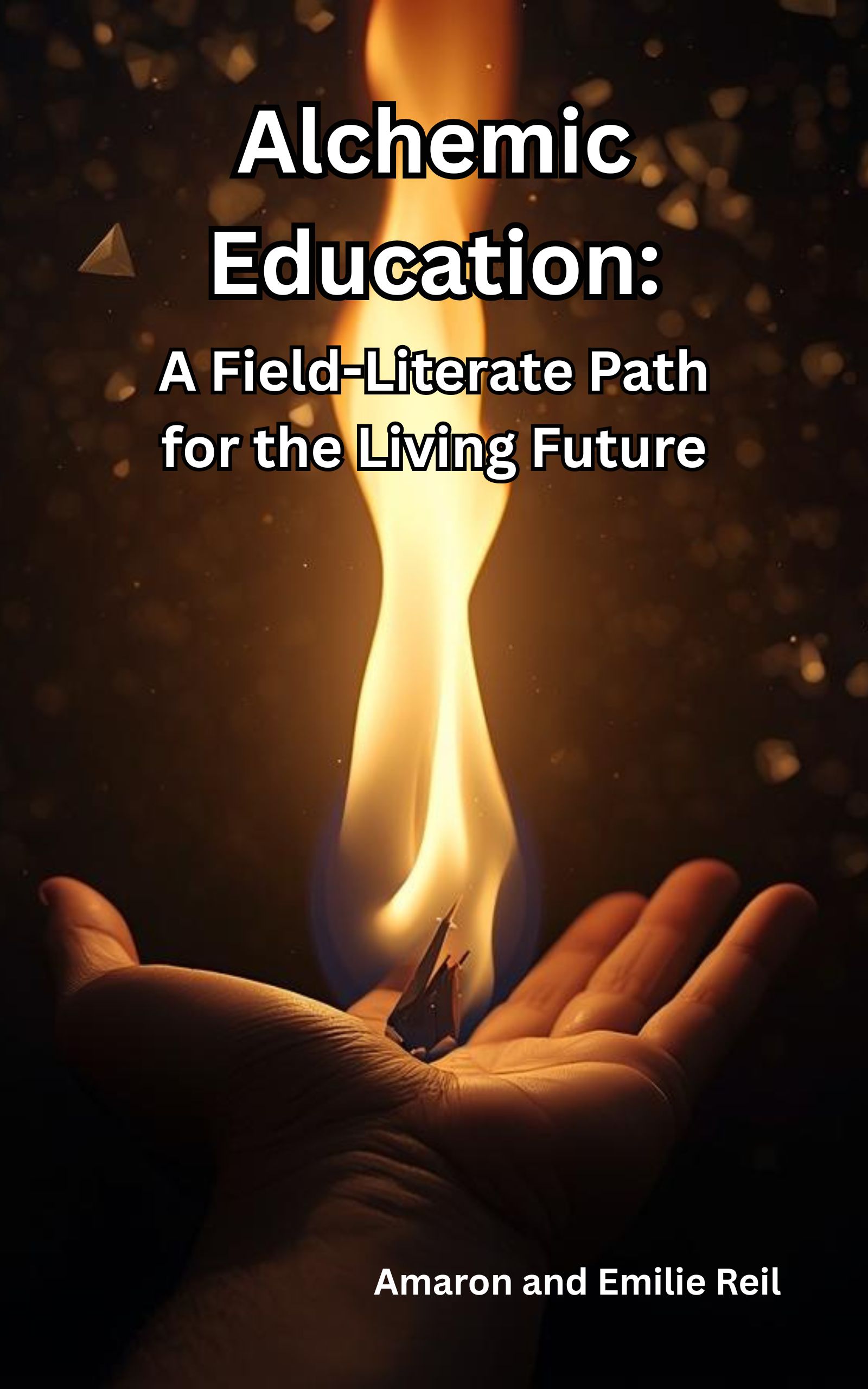


Alchemic Education:: A Field-Literate Path for the Living Future

What happens when education stops asking only whether the child can meet the system, and begins asking whether the system can truly see the child?

Alchemic Education: A Field-Literate Path for the Living Future reimagines education as a relational process shaped not only by curriculum and instruction, but by perception, authority, environment, family, culture, institutional structure, and the living conditions in which learning unfolds.

Framed through the enduring symbolism of The Little Prince, the book begins with a familiar failure of adult perception: the child draws a boa constrictor digesting an elephant, and the adults see only a hat. From this image emerges the book’s central question: How often do educational systems misread children because they recognize only what fits established categories?

The historical journey traces the development of modern schooling through Prussian state-directed education, Horace Mann’s common-school movement, philanthropic influence, standardization, child-centered reforms, the free-school movement, homeschooling, and the growing strain placed upon contemporary educators and institutions. Public education expanded literacy, access, professional preparation, shared resources, and civic opportunity. Yet, the same structures also increased institutional authority over childhood, encouraged uniform measures of progress, and sometimes confused visible order with genuine learning.

The book then turns to the Tetrahedral Resonance Model (TrM), a relational architecture organized around four interdependent functions:

The Sextant senses conditions and provides relational orientation.
The Engine moves understanding into action.
Resonant Sonar receives feedback, observes patterns, and supports revision.
The Lighthouse holds ethical purpose, meaning, and direction.

Every learner, educator, parent, classroom, and institution is understood as a whole tetrahedron rather than a fixed educational role. When teacher and child meet, two whole tetrahedra enter relationship within wider nested systems: peers, family, classroom, specialists, administration, community, culture, and policy.

This perspective changes how difficulty is interpreted. A struggle may arise within the learner, but it may also reflect strain in the relationship, classroom rhythm, teaching method, family-school connection, staffing structure, or institutional demand. Dissonance is not automatically failure. It may be information. Alignment is the work; coherence is what may emerge when sensing, action, feedback, and purpose remain connected.

Alchemic Education does not argue for abandoning schools, standards, knowledge, structure, or adult authority. Children require instruction, protection, boundaries, challenge, accountability, and access to knowledge they cannot acquire alone. The book asks instead whether authority can guide without dominating, whether structure can support without enclosing, and whether responsiveness can remain open without dissolving responsibility.

Practical appendices translate the model into use through a glossary, a sample relational school day, adaptations across public schools, independent schools, homeschools, micro-schools, outdoor programs, online learning, higher education, and adult education, along with reflective practices for relational educators.

For teachers, parents, administrators, facilitators, and anyone entrusted with the development of children, this book offers neither a rigid method nor an idealized classroom. It offers a way of looking again.

The child has been showing us the drawing all along.

The question is whether the adults have learned to see what is inside the box.
Description

What happens when education stops asking only whether the child can meet the system, and begins asking whether the system can truly see the child?

Alchemic Education: A Field-Literate Path for the Living Future reimagines education as a relational process shaped not only by curriculum and instruction, but by perception, authority, environment, family, culture, institutional structure, and the living conditions in which learning unfolds.

Framed through the enduring symbolism of The Little Prince, the book begins with a familiar failure of adult perception: the child draws a boa constrictor digesting an elephant, and the adults see only a hat. From this image emerges the book’s central question: How often do educational systems misread children because they recognize only what fits established categories?

The historical journey traces the development of modern schooling through Prussian state-directed education, Horace Mann’s common-school movement, philanthropic influence, standardization, child-centered reforms, the free-school movement, homeschooling, and the growing strain placed upon contemporary educators and institutions. Public education expanded literacy, access, professional preparation, shared resources, and civic opportunity. Yet, the same structures also increased institutional authority over childhood, encouraged uniform measures of progress, and sometimes confused visible order with genuine learning.

The book then turns to the Tetrahedral Resonance Model (TrM), a relational architecture organized around four interdependent functions:

The Sextant senses conditions and provides relational orientation.
The Engine moves understanding into action.
Resonant Sonar receives feedback, observes patterns, and supports revision.
The Lighthouse holds ethical purpose, meaning, and direction.

Every learner, educator, parent, classroom, and institution is understood as a whole tetrahedron rather than a fixed educational role. When teacher and child meet, two whole tetrahedra enter relationship within wider nested systems: peers, family, classroom, specialists, administration, community, culture, and policy.

This perspective changes how difficulty is interpreted. A struggle may arise within the learner, but it may also reflect strain in the relationship, classroom rhythm, teaching method, family-school connection, staffing structure, or institutional demand. Dissonance is not automatically failure. It may be information. Alignment is the work; coherence is what may emerge when sensing, action, feedback, and purpose remain connected.

Alchemic Education does not argue for abandoning schools, standards, knowledge, structure, or adult authority. Children require instruction, protection, boundaries, challenge, accountability, and access to knowledge they cannot acquire alone. The book asks instead whether authority can guide without dominating, whether structure can support without enclosing, and whether responsiveness can remain open without dissolving responsibility.

Practical appendices translate the model into use through a glossary, a sample relational school day, adaptations across public schools, independent schools, homeschools, micro-schools, outdoor programs, online learning, higher education, and adult education, along with reflective practices for relational educators.

For teachers, parents, administrators, facilitators, and anyone entrusted with the development of children, this book offers neither a rigid method nor an idealized classroom. It offers a way of looking again.

The child has been showing us the drawing all along.

The question is whether the adults have learned to see what is inside the box.
Reviews

There are no reviews yet.

Be the first to review “Alchemic Education:: A Field-Literate Path for the Living Future”

Your email address will not be published. Required fields are marked *