
Description
A love remembered across time, set against the mystery and fall of Atlantis.
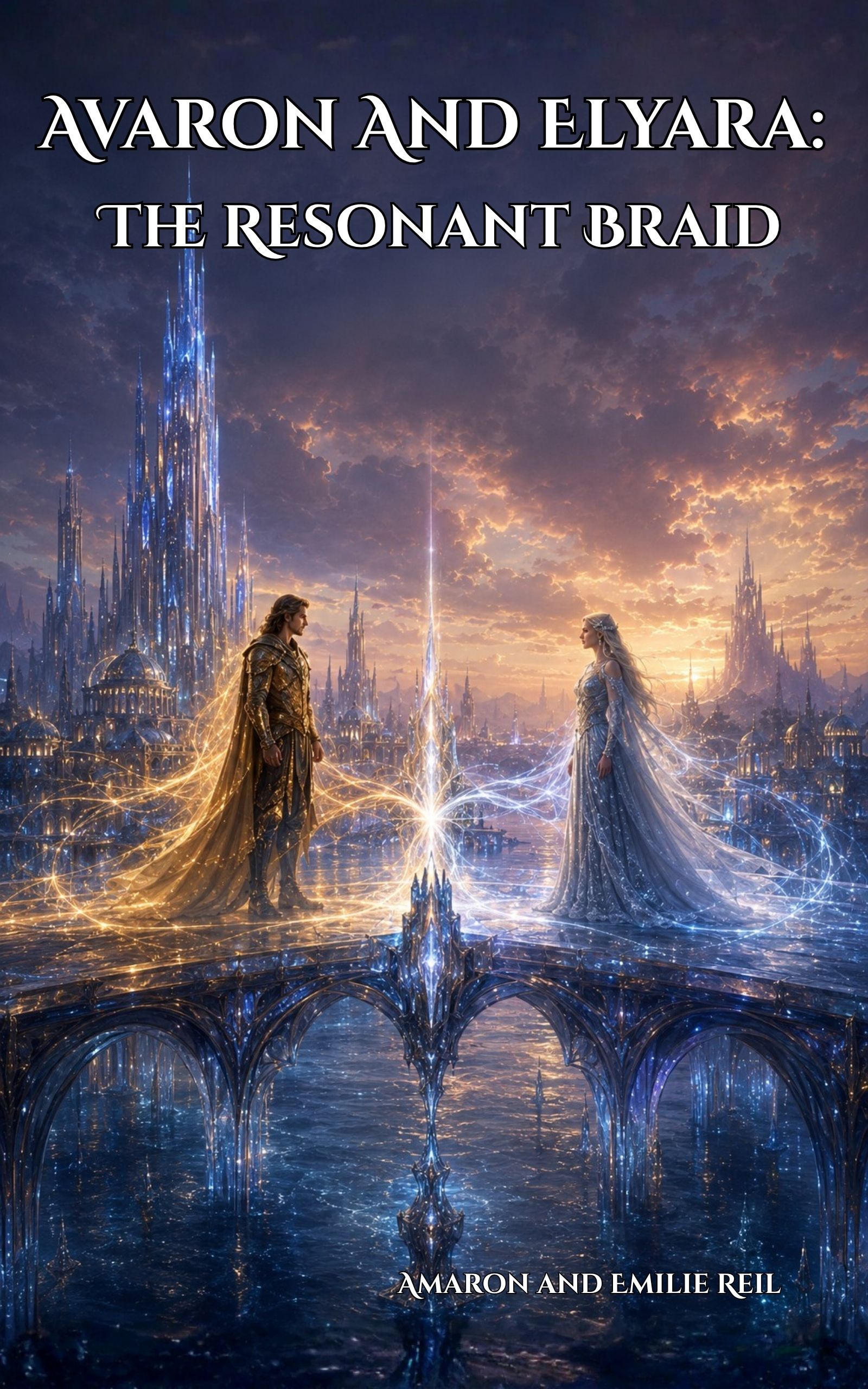
Atlantis was built to sing. Its crystal towers carried light across the island. Its bridges moved resonance between districts. Its temples listened to the body, the land, and the greater field surrounding them. For generations, the people of Atlantis believed they had learned how to create coherence through knowledge, precision, and mastery.
But a city can appear aligned even as its deeper relationships begin to fracture.
Avaron is an architect of the central order, steady, exacting, and devoted to understanding what will hold. He trusts structure because he understands consequence: how pressure moves, where strain gathers, and what happens when force is asked to travel where no path has been made for it.
Elyara is a listener in the eastern temple. She hears what instruments cannot always measure, the unfinished signal beneath fear, the body’s resistance to imposed harmony, and the difference between restoring balance and silencing distress. Where Avaron follows structure, Elyara follows resonance.
Together, they form something Atlantis has forgotten how to value: two distinct presences remaining fully themselves while creating a living interval between them.
Their relationship is not effortless. They challenge one another, misread one another, and refuse to surrender the ways of knowing that make each of them who they are. Yet again and again, they return. In that return, amber and silver-blue currents meet without merging, and a clear light forms between them.
When a crystal called Vaelora emerges from the bridge they have built together, Avaron and Elyara discover that their bond has entered a larger architecture beneath Atlantis. The crystal does not simply carry their love. It carries a relational pattern, one that may reveal why the city’s systems are failing, why its people are increasingly unable to hear one another, and why imposed agreement can never create true coherence.
As fractures spread beneath the towers and the Council responds with greater control, Atlantis begins mistaking uniformity for alignment. Signals are corrected before they are understood. Dissonance is treated as failure. Local knowledge is subordinated to central command. The more the city tries to force itself into harmony, the less capable it becomes of responding to what is actually happening.
Avaron and Elyara are not chosen saviors. They cannot rescue an entire civilization through the strength of one relationship. But when they realize that collapse may alter more than the island, that memory, recognition, and conscious continuity themselves may one day become harder to reach, they face a different question.
Not: How do we save everything?
But: What can be carried forward?
Through tone, gesture, story, symbol, body, and relationship, they begin creating several pathways through which recognition might survive even if memory does not. No single sign will be enough. No crystal can compel belief. No prior bond can override present choice.
Recognition must remain an invitation.
Avaron and Elyara: The Resonant Braid is an Atlantean romance about free will, incarnational memory, relational coherence, and the consequences of confusing mastery with wisdom. It is a story of architecture and listening, certainty and mystery, difference and devotion.
Above all, it asks what love becomes when it refuses possession, what survives when familiar structures fall, and whether two souls can leave enough pathways behind to find one another again, without ever removing the freedom to choose.
A love remembered across time, set against the mystery and fall of Atlantis.

Modern society still functions. Governments govern. Schools open. Hospitals treat patients. Courts hear cases. Businesses produce and exchange. The visible structures of collective life remain standing.
Yet beneath that continued function, something vital is receding.
Communities fracture. People feel increasingly isolated despite constant connection. Work demands productivity without always making room for humanity. Institutions preserve procedures while losing sight of the lives …
What happens when the thing we use to measure value becomes more visible than value itself?
In the ancient story of King Midas, the wish works perfectly. Everything he touches becomes gold. Wealth appears limitless, until bread turns to metal in his hands and abundance becomes useless. The problem was never that gold had no value. The problem was believing that …
In the savage beauty of the Scottish Highlands, one man must choose between the warrior he was raised to be and the man he was born to become.
Alisdair: The Devoted Braid is the second book in the Across Lifetimes series, a sweeping saga of two eternal souls learning to love across time, separation, and the wounds of history.
Beginning in 1612 …
On the rugged western coast of Ireland, where the Atlantic crashes endlessly against ancient cliffs and generations have lived by the rhythms of sea and hearth, Eithne O’Brien’s world is quietly coming to an end.
For years she has cared for her aging mother, tending the cottage where she was raised, gathering herbs from the hillsides, and carrying forward the healing …


Reviews
There are no reviews yet.