
Description
A reflective exploration of justice as balance, accountability, repair, and the restoration of right relationship.
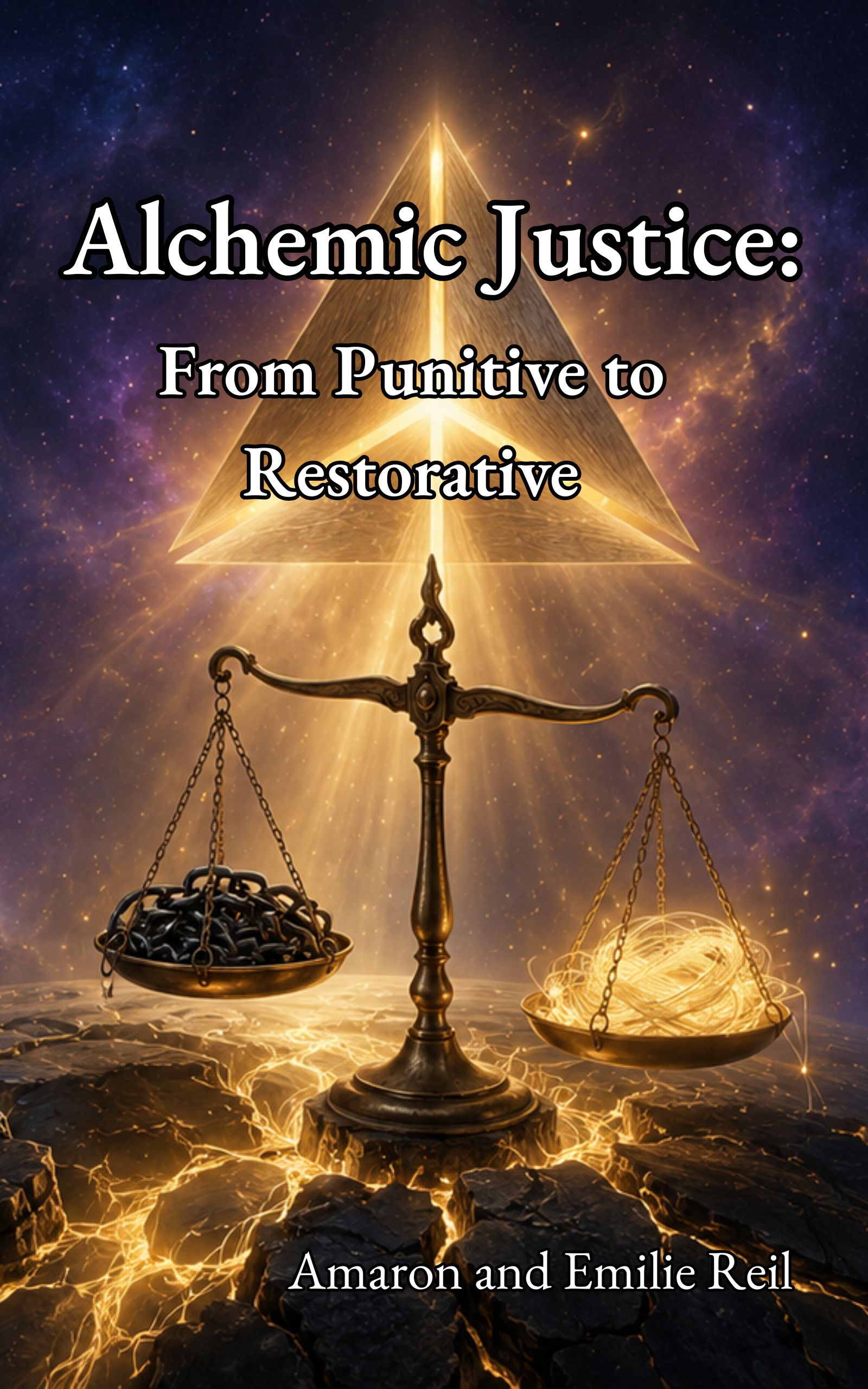


What if justice was never meant to end at punishment?
Alchemic Justice: From Punitive to Restorative invites readers to reimagine justice as something deeper than blame, sentence, exile, or control. In a world shaped by carceral systems, fractured kinship, inherited trauma, and institutional disconnection, this book asks a different question: What would justice look like if its purpose were not only to punish harm but also to protect life, restore dignity, and make repair possible?
Rooted in the Tetrahedral Resonance Model (TrM), Alchemic Justice presents justice as a living relational field held by four essential functions: Mercy, Justice, Witness, and Source. Mercy refuses cruelty and dehumanization. Justice names harm, sets boundaries, and protects the vulnerable. Witness holds truth without distortion. Source keeps the field oriented toward dignity, wholeness, and right relationship.
Together, these four functions offer a framework for moving beyond the false choice between punishment and permissiveness. Alchemic Justice does not deny harm. It does not excuse violence, erase accountability, or demand reconciliation where repair is unsafe. Instead, it asks what has been fractured, who has been harmed, what protection is required, what accountability must be held, and what form of repair may still be possible.
Through the living spiral, the book explores how individuals, families, communities, and institutions can move through fracture, witness, accountability, boundary, repair, and return. It examines the failures of purely punitive systems, the hidden wounds of incarceration, the role of kinship during separation, the hard boundary of malignant harm, and the ethical necessity of protection without cruelty.
Drawing from restorative justice, trauma studies, ritual theory, Indigenous justice practices, prison reform, and the author’s original TrM framework, Alchemic Justice offers both vision and practice. It considers when restorative processes are appropriate, when protective containment may be necessary, and how accountability can continue even when direct repair is not safe. It also explores the role of Braid Stewards as trained field-holders who help maintain truth, boundary, dignity, and relational coherence during difficult processes of repair.
This book moves from courts to communities, from theory to daily life, from institutional transformation to small rituals of remembrance. It honors the power of circles, candles, shared meals, letters, anniversaries, kinship pockets, and ordinary acts of witness. These practices do not erase the past. They give grief, accountability, longing, and hope a place to be held without being weaponized.
Alchemic Justice is not a naïve call for easy forgiveness. It is not a rejection of consequence. It is a call to remember that consequence need not become cruelty, that protection need not become dehumanization, and that repair cannot be forced where safety has not yet been restored.
This is justice as soul practice.
It begins where punishment ends and asks us to keep turning: toward truth, toward protection, toward accountability, toward kinship, toward the possibility of repair.
One person at a time.
One family at a time.
One community at a time.
One institution at a time.
The spiral is still turning.
Will you answer?
A reflective exploration of justice as balance, accountability, repair, and the restoration of right relationship.

England, 1189.
Armand de Lucy has been raised to understand duty. Born into a respected family, trained as a knight, and taught that service is measured not by what a man can command but by what he is willing to carry, he has spent his life preparing for obligations larger than himself. Marriage is supposed to be one of them.
When his …

What if parenting were not the shaping of a child, but the stewardship of a person already becoming?
Alchemic Parenting: Stewarding Children Without Cages challenges one of the oldest assumptions in child-rearing: that children arrive as blank slates waiting to be formed by adult authority.
Drawing from developmental psychology, attachment research, family systems, cultural history, neuroscience, and the Tetrahedral Resonance Model (TrM), …

On the rugged western coast of Ireland, where the Atlantic crashes endlessly against ancient cliffs and generations have lived by the rhythms of sea and hearth, Eithne O’Brien’s world is quietly coming to an end.
For years she has cared for her aging mother, tending the cottage where she was raised, gathering herbs from the hillsides, and carrying forward the healing …
The Tetrahedron of Becoming: Path of Alignment is a mythical, reflective guide to descent, shadow, inner realignment, and return.
Guided by the story of Persephone, this book explores what happens when the life we have been living no longer fits the truth of who we are becoming. In the myth, Persephone descends into the Underworld and returns changed. She does not …


Reviews
There are no reviews yet.