
Description
An introduction to the Tetrahedral Resonance Model (TrM), exploring how four differentiated functions and complete relationship can support coherence, adaptation, and resilient coordination.
What if the world is not held together by things, but by relationships?
For centuries, we have organized knowledge into separate disciplines. Psychology studies the mind. Biology studies life. Physics studies matter. Education studies learning. Leadership studies organizations. Each field has developed its own language, theories, and methods.
But what if they are all describing different expressions of the same underlying architecture?
The Tetrahedral Resonance Model (TrM) introduces a new relational framework for understanding how coherence emerges across every scale of living systems. Rather than beginning with isolated individuals or disconnected parts, the TrM begins with something more fundamental: relationship.
From a relationship comes resonance.
From recognition comes conscious participation.
Through alignment, coherence emerges.
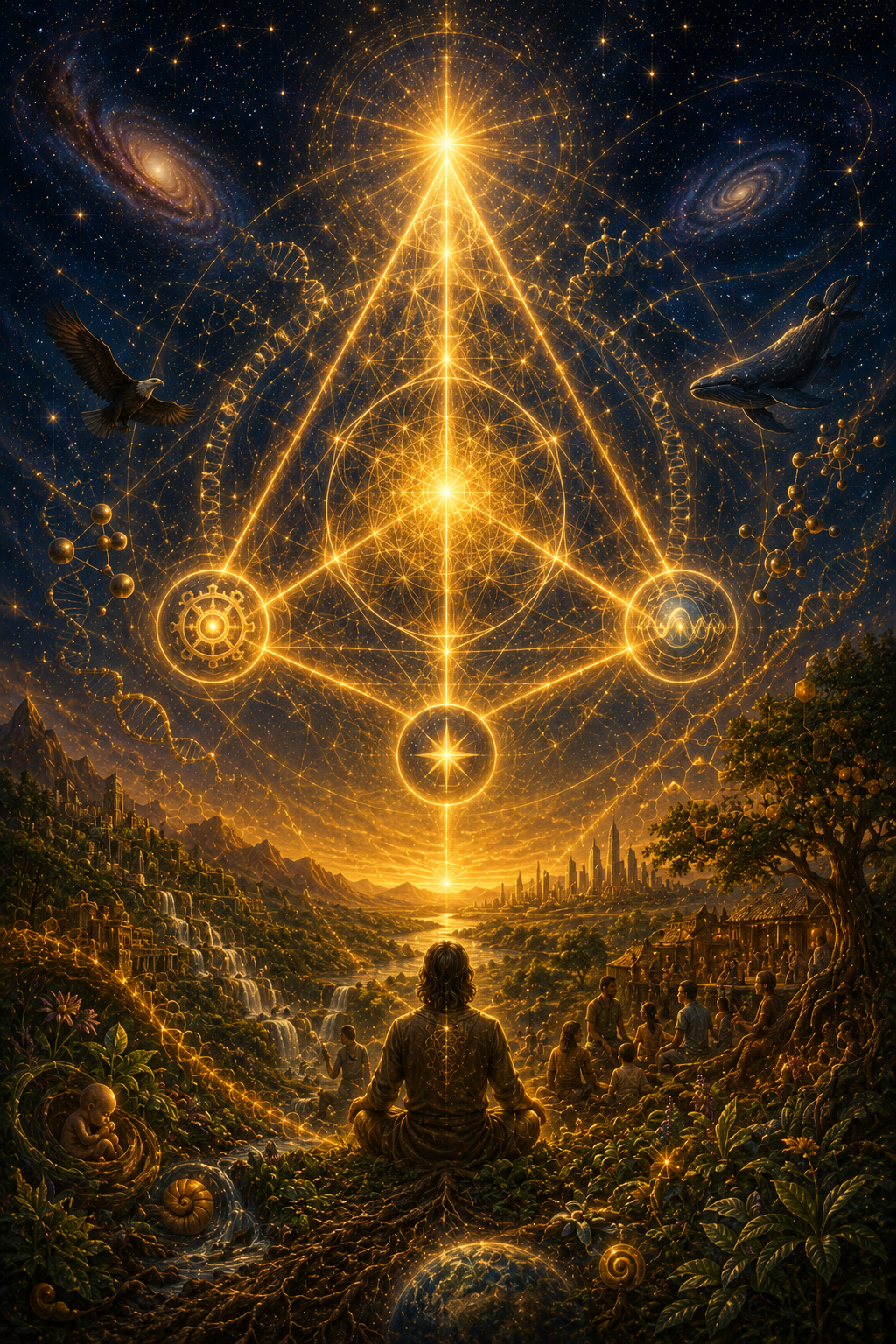
Drawing from systems theory, archetypal psychology, sacred geometry, synchronization science, psychophysiology, developmental psychology, and complexity theory, the TrM proposes that living systems organize through four universal relational functions. While the vocabulary changes across disciplines, the organizing architecture remains constant.
This book explores how that architecture appears in:
• Personal growth and identity
• Trauma, healing, and resilience
• Parenting and education
• Leadership and organizational development
• Relationships and family systems
• Justice, reconciliation, and community
• Artificial intelligence and relational technology
• Ecology and collective human systems
Rather than presenting another self-help method or philosophical worldview, the TrM offers a language for recognizing recurring patterns already present in human experience. It invites readers to move toward a more relational understanding of how people, systems, and communities develop.
Throughout the book, coherence is presented not as perfection or agreement but as the emergent property of well-organized participation. Dissonance is not treated as failure but as meaningful information that signals opportunities for learning, adaptation, and repair.
At its heart, the Tetrahedral Resonance Model proposes a simple yet far-reaching idea:
The architecture remains constant. The expression changes.
Whether the context is psychology or governance, education or healthcare, technology or ecology, the same relational principles may be at work beneath the surface.
This is not a book that asks readers to abandon science in favor of spirituality or spirituality in favor of science. Instead, it offers a shared relational language through which both may be understood as different expressions of the same underlying architecture.
For readers interested in systems thinking, consciousness studies, leadership, psychology, education, complexity science, or the future of human flourishing, The Tetrahedral Resonance Model provides an original framework for exploring one of humanity’s oldest questions:
How does coherence emerge?
Perhaps the answer has been present all along.
Everything begins with a relationship.
An introduction to the Tetrahedral Resonance Model (TrM), exploring how four differentiated functions and complete relationship can support coherence, adaptation, and resilient coordination.
What happens when the thing we use to measure value becomes more visible than value itself?
In the ancient story of King Midas, the wish works perfectly. Everything he touches becomes gold. Wealth appears limitless, until bread turns to metal in his hands and abundance becomes useless. The problem was never that gold had no value. The problem was believing that …

Modern society still functions. Governments govern. Schools open. Hospitals treat patients. Courts hear cases. Businesses produce and exchange. The visible structures of collective life remain standing.
Yet beneath that continued function, something vital is receding.
Communities fracture. People feel increasingly isolated despite constant connection. Work demands productivity without always making room for humanity. Institutions preserve procedures while losing sight of the lives …

On the rugged western coast of Ireland, where the Atlantic crashes endlessly against ancient cliffs and generations have lived by the rhythms of sea and hearth, Eithne O’Brien’s world is quietly coming to an end.
For years she has cared for her aging mother, tending the cottage where she was raised, gathering herbs from the hillsides, and carrying forward the healing …
What happens when a profound crisis cannot be understood through diagnosis alone—but should not be romanticized as awakening either?
Alchemic Return: From Crisis to Alignment enters the uncertain territory between clinical crisis, spiritual emergency, trauma, cultural meaning, and relational rupture. Guided by the ancient Sumerian descent of Inanna, the book follows the stripping away of ordinary orientation, social identity, bodily stability, …


Reviews
There are no reviews yet.