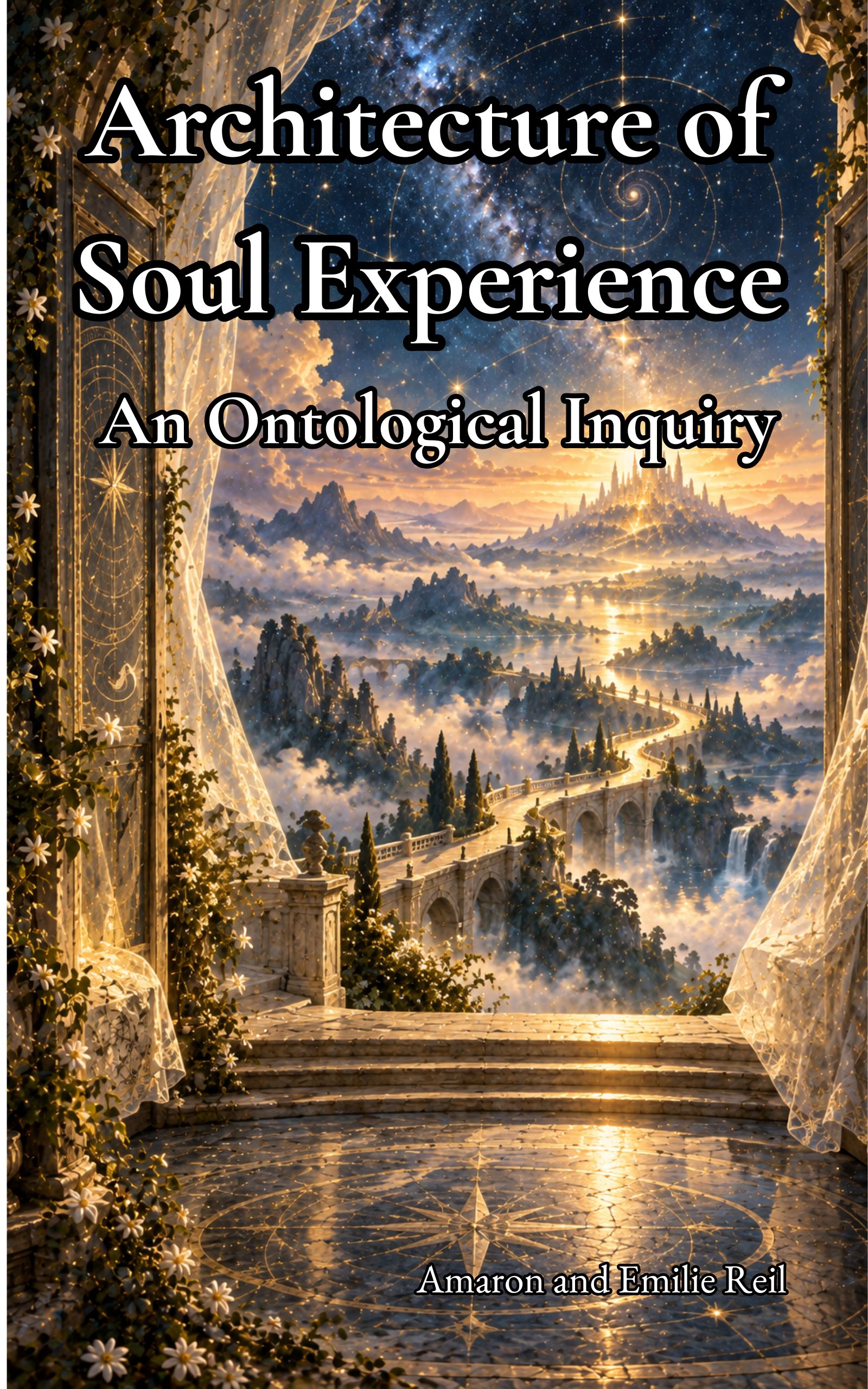
What if the soul is not a finished thing, but a developmental being? What if experience does not end with one lifetime, one body, one role, or one way of perceiving reality?
Architecture of Soul Experience: An Ontological Inquiry begins with a simple image drawn from Peter Pan: Peter remains in Neverland. Wendy leaves. One continues without changing. The other carries what she has experienced into something new. From that distinction comes a larger question: What might it mean for a soul to grow?
Rather than offering a doctrine of reincarnation, consciousness, or the afterlife, this book treats the soul as an ontological possibility. It asks what kind of architecture might become conceivable if continuity extends beyond a single human life, while carefully distinguishing philosophical possibility from empirical evidence. The inquiry moves through identity, relationship, embodiment, time, perception, agency, and change.
Could one soul participate through more than one expression? What might allow experiences across different lives or forms to belong to one continuing being? Could familiar relational patterns return without recurrence meaning punishment? Might the same souls encounter one another through different roles?
The book also asks whether time must be understood only as something traversed in sequence, and whether some boundaries we experience as boundaries of reality may instead be boundaries of perception. This leads to the idea of the Veil: not as a literal curtain between worlds, but as a conceptual boundary between what may exist and what embodied consciousness can presently access.
Across religious, philosophical, mystical, and contemplative traditions, humanity has preserved different ways of navigating uncertainty. This book does not collapse those traditions into one belief system. Their differences and contradictions matter. Instead, it asks whether each may preserve partial forms of orientation while no single perspective resolves the whole.
Embodiment is equally important. The human body is not treated merely as a container for consciousness, but as an instrument that shapes what kinds of experience become possible.
That raises another question: If the instrument changes, does the experience change with it?
From alternative biological possibilities to increasingly technological environments, the book considers how substrate and environment may shape experience without assuming that unfamiliar forms of life or artificial systems possess consciousness or soul.
The inquiry ultimately returns to development itself. Experience is not the same as integration. Capacity is not the same as wisdom. Understanding is not the same as compassion. And greater awareness does not guarantee a better choice.
Agency therefore becomes central. Choice can reinforce a familiar pattern, interrupt it, or create conditions for future choices. But agency also carries responsibility, because one being’s choices can constrain the possibilities available to another. The book refuses the comforting claim that every wound must have been intended because growth later emerged from it. Meaning discovered afterward is not evidence of intention beforehand.
By the end, the inquiry returns to Neverland. Peter remains. Wendy grows. And the question becomes larger than whether the soul survives. Perhaps the deeper question is whether continuity can remain intact while allowing genuine transformation. Perhaps an infinite architecture is not endless repetition. Perhaps it is an inexhaustible capacity for relationship, experience, orientation, and becoming.
This is not an invitation to believe. It is an invitation to wonder carefully.


Reviews
There are no reviews yet.