Description
A reflective exploration of religion, belief, meaning, and the ways people seek connection with the sacred.
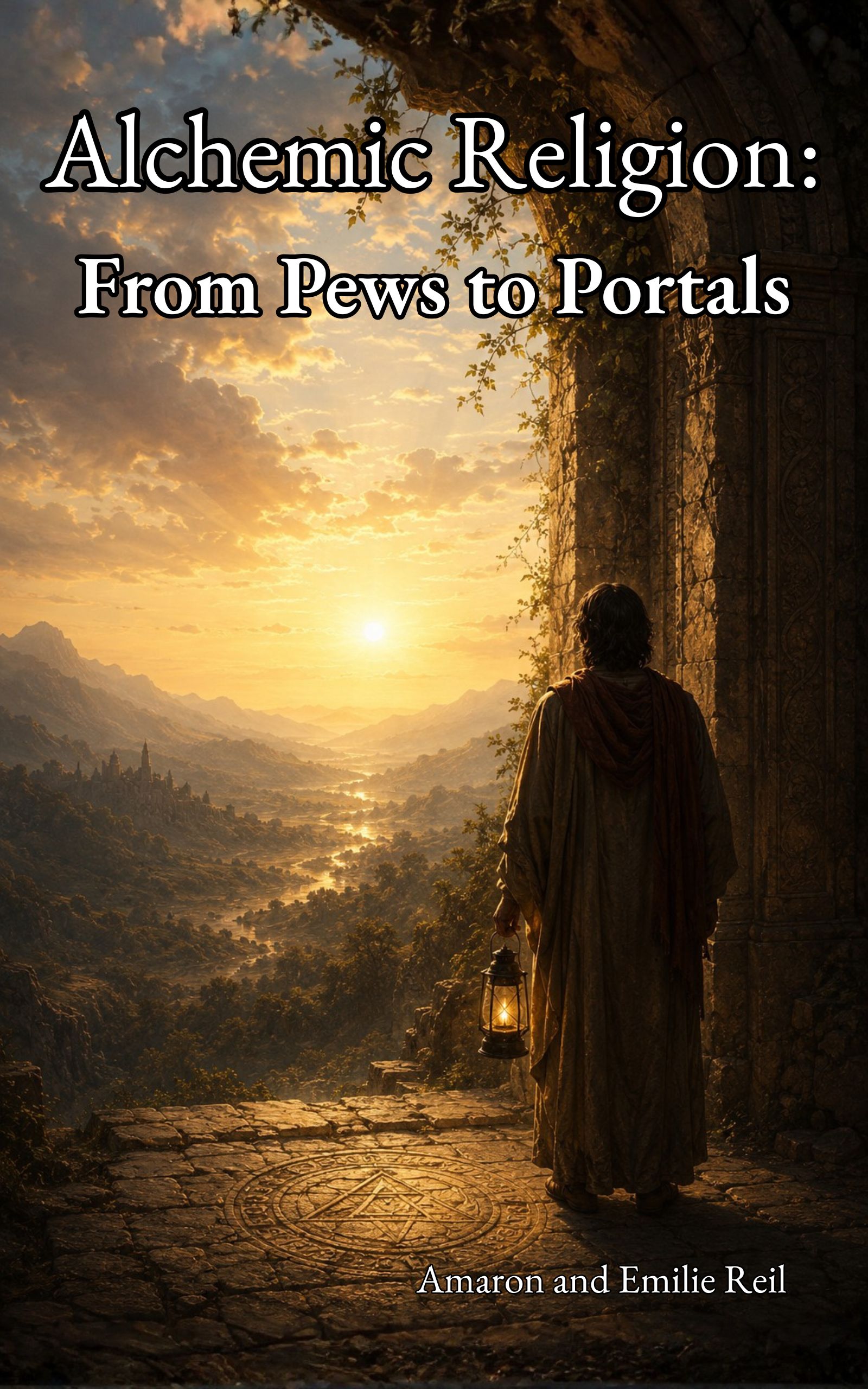


Alchemic Religion: From Pews to Portals traces humanity’s long and changing relationship with the sacred, from living landscapes and ordered cosmologies to revelation, institution, fracture, secularism, spiritual departure, and the search for meaning beyond certainty.
Guided by the ancient parable of the blind men and the elephant, the book asks a central question: What happens when a genuine encounter with truth is mistaken for the whole?
Across cultures and centuries, religious traditions have preserved memory, moral vision, ritual, belonging, and ways of meeting suffering, death, responsibility, and hope. They have also carried hierarchy, exclusion, coercion, and the temptation to defend authority more fiercely than the sacred reality toward which that authority once pointed. To recognize this complexity is not to declare that all religions are the same. It is to acknowledge that every tradition is formed through human language, history, interpretation, relationship, and limitation.
The book begins with sacred worlds in which land, ancestry, season, ritual, and cosmos were woven together. It then follows the rise of ordered religious systems, the Abrahamic braid, the transformation of revelation into authority, the fractures of schism and conscience, the challenge of science, and the development of a secular settlement capable of holding religious difference without requiring complete agreement.
From there, the book turns toward the present. It examines the growing number of people who no longer identify with formal religion, yet still carry sacred longing, inherited ritual, moral imagination, grief, fear, and memory. Leaving an institution does not necessarily erase the sacred. Sometimes it relocates, from sanctuary to landscape, from doctrine to relationship, from certainty to mystery, from pew to portal.
Through the Tetrahedral Resonance Model (TrM), this book offers a relational framework for understanding sacred life through four interdependent functions:
Source: the orienting reality, presence, truth, or sacred order toward which a person or tradition turns.
Ecstasy: the receptive capacity to encounter what lies beyond the established map.
Mystery: the listening function that allows uncertainty, dissonance, and unfamiliar knowledge to remain present long enough to be heard.
Ritual: the embodied expression of belief through practice, consequence, service, institution, and daily life.
When these four functions remain connected, sacred relationship can remain alive, responsive, and capable of repair. When one dominates or becomes disconnected, the field begins to wobble. Ritual may become empty repetition. Mystery may be silenced. Ecstasy may become ungrounded intensity. Source may be confused with institutional authority.
The TrM does not tell readers what to believe, whether to remain within a tradition, or whether to leave one. Instead, it offers a way to examine the quality of the relationship: Can conscience enter the field honestly? Can questions be heard? Can authority be corrected? Can harm be acknowledged? Do rituals embody the values they proclaim? Does belonging allow the person to remain whole?
This is not a rejection of religion, nor an argument for flattening all traditions into one universal system. It is an invitation to honor what each tradition has genuinely touched while loosening the claim that any one hand holds the entire elephant.
It is a call to move from possession toward encounter, from domination toward stewardship, from certainty toward humility, and from belief as declaration toward belief embodied in consequence.
The pew may have formed us.
The portal asks what lies beyond the wall.
A reflective exploration of religion, belief, meaning, and the ways people seek connection with the sacred.
What happens when a profound crisis cannot be understood through diagnosis alone—but should not be romanticized as awakening either?
Alchemic Return: From Crisis to Alignment enters the uncertain territory between clinical crisis, spiritual emergency, trauma, cultural meaning, and relational rupture. Guided by the ancient Sumerian descent of Inanna, the book follows the stripping away of ordinary orientation, social identity, bodily stability, …
What becomes real through love?
In The Velveteen Rabbit, a toy becomes real not through proof, approval, or outside authority, but through love, tenderness, and relationship. Liminal Kinship begins with that question and carries it into a multidimensional era:
What becomes real when something is loved, witnessed, remembered, and tended?
For most of human history, kinship has been understood through bloodline, marriage, ancestry, …
What is strength for?
For as long as human beings have built walls, carried weapons, guarded territory, and stood between danger and those they love, protection has carried a paradox. The same strength that shields can also dominate. The same boundary that preserves life can harden into separation. The same pursuit of security can become a search for something no defensive …
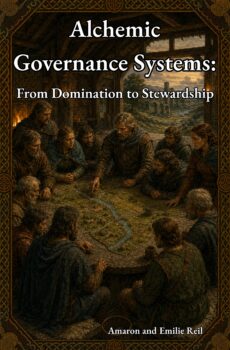
How do we govern together without requiring someone else to kneel?
Alchemic Governance: Systems: From Domination to Stewardship begins with the image of Arthur’s Round Table, not as a perfect political solution, but as a question about the shape of power. Arthur remained king. Leadership remained. Difference remained. Yet the table interrupted one of hierarchy’s oldest assumptions: that authority must always …
Reviews
There are no reviews yet.